

Diffraction patterns 1
Laser diffraction experiments can be conducted using an optical bench, as shown below. Light from the laser (of wavelength λ) is diffracted by a mask (usually a small aperture or grating) and projected onto the screen, located at a large distance away, such that Fraunhofer geometry applies. The light on the screen is known as the diffraction pattern.
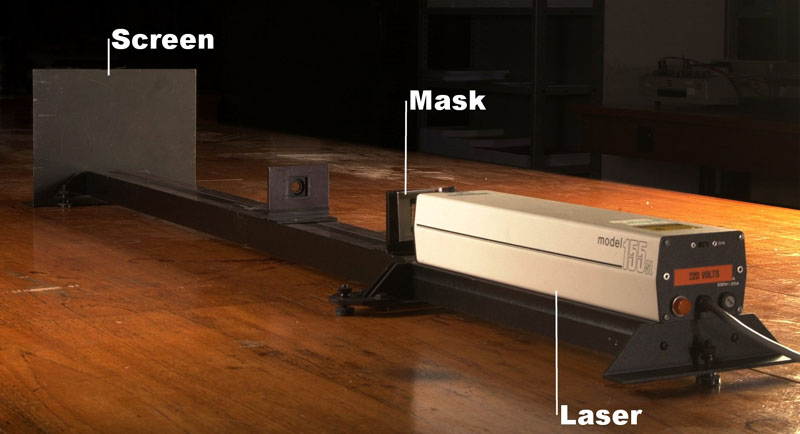
Optical Bench (Click on image to view larger version.)
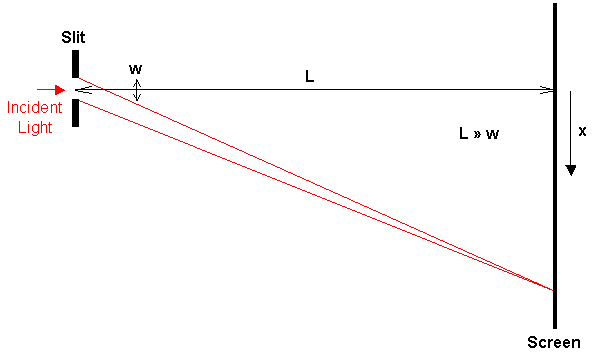
The form of the diffraction pattern from a single slit mask, of width w, involves the mathematical “sinc function”, where
\[{\rm{sinc}}(z) = \frac{{\sin (z)}}{z}\]
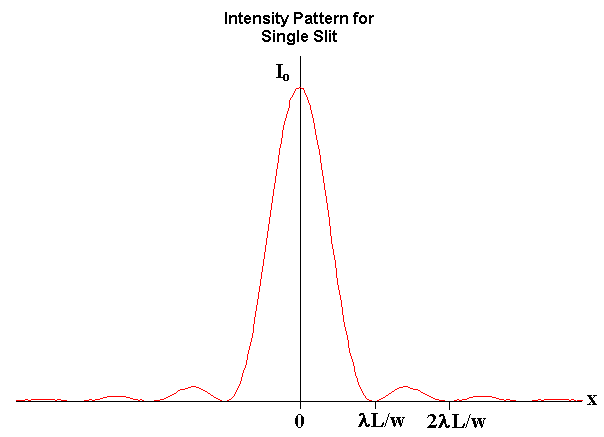
The observable pattern projected onto the screen (a distance L away) has an intensity pattern as follows, where x is the distance from the straight-through position:
\[I(x) = {I_{\rm{o}}}{\rm{sin}}{{\rm{c}}^{\rm{2}}}\left( {\frac{{\pi xw}}{{\lambda L}}} \right)\]
Note that sinc(0) = 1.
Diffraction patterns can be calculated mathematically. The operation that directly predicts the amplitude of the diffraction pattern from the mask is known as a Fourier Transform (provided the conditions for Fraunhofer Diffraction are satisfied). The derivation of some simple patterns can be found here.
 |
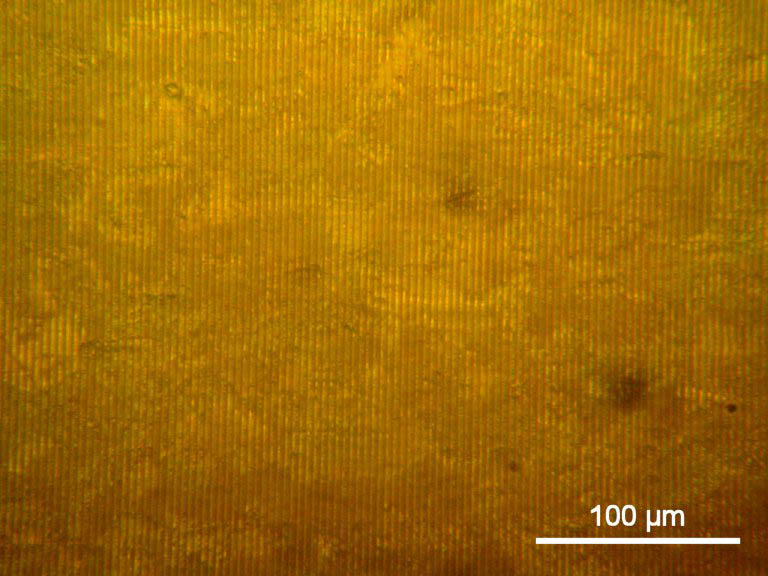 |
|
(a) s = 12 μm |
(b) s = 3 μm |
|
Diffraction gratings (Click on image to view larger version) |
|
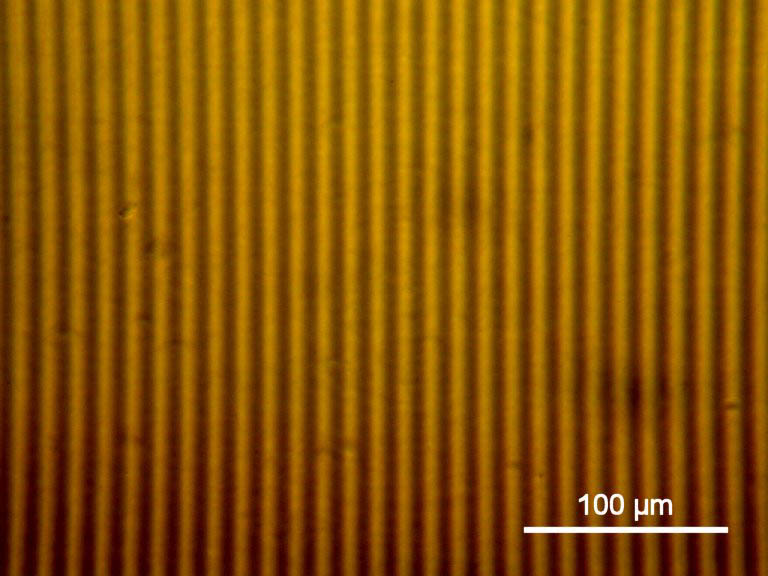
A diffraction grating is effectively a multitude of equally-spaced slits. The diffraction pattern from a complex mask such as a grating can be constructed from simplier patterns via the convolution theorem. The observed diffraction pattern is composed of repeated "sinc-squared" functions. Their positions from the central spot are determined by s (the spacing between slits) and their relative intensity is dependent on w (the width of individual slits).
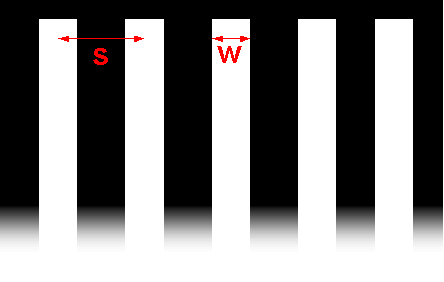
Slit spacing s and slit width w
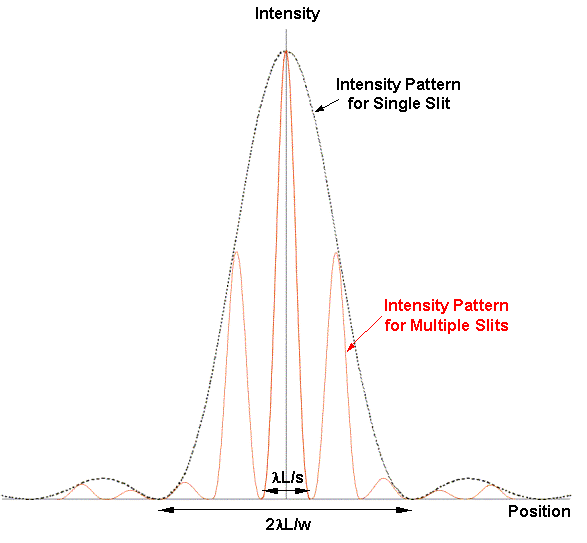

Diffraction patterns from gratings (a) and (b). (Click on image to view a larger version.)