

Microstructural effects
If a material contains grains, the grains will act as diffusion pathways, along which diffusion is faster than in the bulk material.
Consider a cylindrical grain of radius r and grain boundary thickness δ
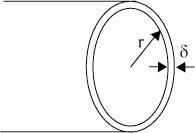
The area of the grain boundary in the cross section is 2π r δ.
Every grain boundary is shared between two grains, so the total grain boundary area associated with one grain is π r δ.
The ratio of the area of the grain boundary to the bulk is:
\[\frac{{\pi r\delta }}{{\pi {r^2}}} = \frac{\delta }{r} = \frac{{2\delta }}{d}\]
The overall flux through unit cross-sectional area is the sum the fluxes through the bulk and the grain boundary:
\[J = {J_\rm{b}} + {J_\rm{gb}}\frac{{2\delta }}{d}\]
The derivation for this equation is here
Therefore:
\[{D_{{\rm{measured}}}} = {D_{\rm{b}}} + {D_{{\rm{gb}}}}\frac{{2\delta }}{d}\]
It is important to realise that δ is very small, therefore grain boundary diffusion only becomes significant when Dgb >> Db, i.e. at low temperatures.
The following animation shows the effect of microstructure on diffusion at various temperatures:
Dislocations have a similar effect, providing fast diffusion paths due to the disruption in the lattice, again with only a significant effect at low temperatures.