

• Electrodes
A significant advantage of the MCFC is that non-noble metals can be used as electrodes. At the high operating temperature, a Nickel anode and the Nickel oxide cathode is able to promote the electrochemical reaction. This means lower production costs compared to low temperature fuel cell, where the catalyst electrode is usually made of platinum. The Ni electrodes are less prone to CO poisoning, hence coal based fuel can be used, especially since internal reforming can take place.
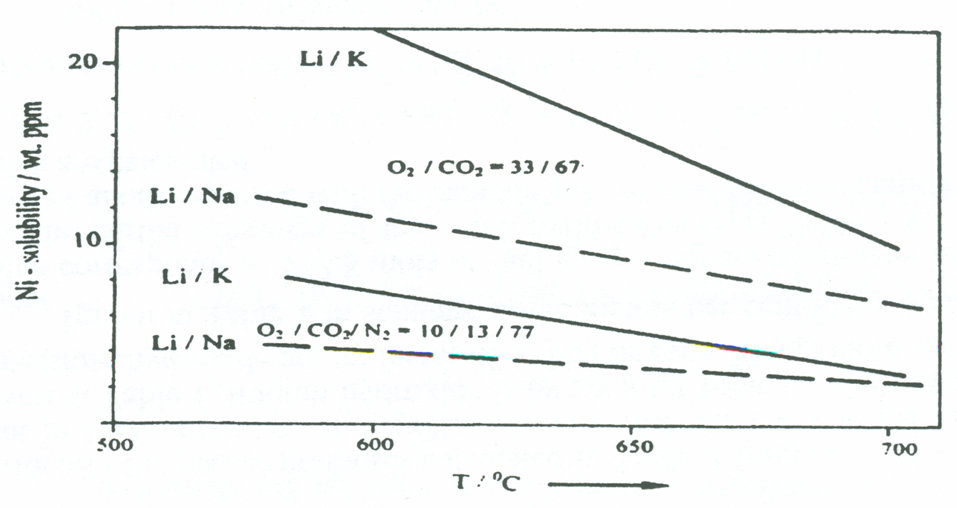 Solubility of electrode in electrolyte
The main problem with the electrodes is their solubility in the electrolyte by Ostwald ripening, which is a dissolution/reprecipitation process. It decreases the internal surface of the porous nickel oxide cathode, causing it to deteriorate. The solubility of nickel oxide (cathode material) is dependant on the cathode potential and temperature. The solubility of Ni and NiO in Li/Na was found to be lower than in Li/K melts.
Although Li/Na melts have been found to have superior performance compared to Li/K melts, the lower oxygen solubility reduces the cathode performance on lean gas with a low oxygen partial pressure (below 0.1 bars).