

Young´s Modulus - Strength selection map
The Young’s modulus – strength materials-selection map is used in conjunction with merit indices relating to elastic deformation and elastic energy storage. For simple tensile loading, to assess differences in maximum recoverable elastic deformation, the merit index \({{{\sigma _f}} \over E}\) is used. To compare maximum elastic strain energy per unit volume, the merit index is \({{\sigma _f^2} \over E}\) used, and for the maximum elastic strain energy per unit mass, the merit index \({{\sigma _f^2} \over {E\rho }}\) is used.

To derive the merit index \({{{\sigma _f}} \over E}\) , the cross-sectional shape of the tie in tension of the structure need not be considered, and engineering parameters are not involved in the derivation, making this a simple merit index to derive as follows:
From the definition of Young’s modulus, while the material is behaving elastically:
$$\sigma = E\varepsilon $$
Therefore the maximum elastic strain (i.e. the deformation at the yield point) depends simply on the maximum elastic stress (i.e. stress before failure) which is the strength σf :
\(\varepsilon = {{{\sigma _f}} \over E}\)
So to find the material with the greatest maximum recoverable deformation, the merit index \({{{\sigma _f}} \over E}\) is maximised using the materials-selection chart shown. This involves moving the merit index line towards the bottom and the right of the map. From doing this it can be seen that cartilage, viscid silk, resilin and skin have good values of this merit index.
Cartilage is found on the end of bone in joints and so it is important that it is flexible while not being permanently deformed or breaking when the joints bend. The same argument applies to skin, it would be rather gruesome if our skin split open every time we bent our elbow! The merit index \({{{\sigma _f}} \over E}\) is also used to find the best material for elastic hinges. This explains resilin’s high value of the merit index as it is found in insect wing hinges. The insect only has to pull the wing back and it will then be pulled forward by the elasticity of the hinge (with resilin, this is particularly efficient as it has a very low absorption of energy on elastic bending to and fro - i.e. resilin has a high coefficient of restitution or resilience). This is discussed further in the Elasticity in Biological Materials teaching and learning package.
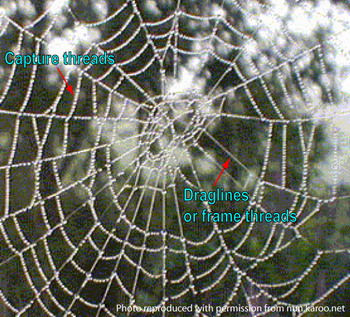
Spider's web
Viscid silk has a high value of this merit index, being able to stretch up to three times its own length. Viscid silk makes up capture threads in a spider’s web: it must entangle flies giving an advantage in a high value. Viscid silk also needs to absorb the kinetic energy of the fly, corresponding to a high \({{{\sigma _f}} \over E}\) value. This is discussed further in the Elasticity in Biological Materials teaching and learning package, where it is noted that viscid silk has (in contrast to resilin) a low coefficient of restitution - this reduces the elastic energy returned to the fly.