TLP contents
Main pages
- Aims
- Before you start
- Introduction
- Experimental matters
- Bragg′s law
- Single crystal diffraction
- Determining lattice parameters accurately
- Relationship between crystalline structure and X-ray data: peak positions, intensities and widths
- Powder diffraction
- Phase identification
- Oriented (or textured) samples
- Summary
- Questions
- Going further
Media resources
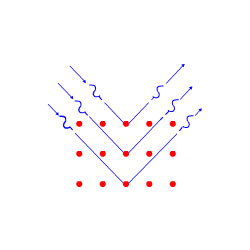
- Scattering diagram (image)
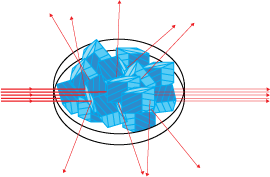
- Diagram of powder scattering (image)
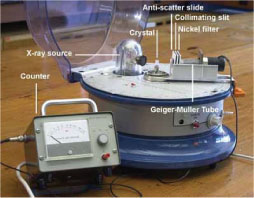
- A simple teaching diffractometer (image)
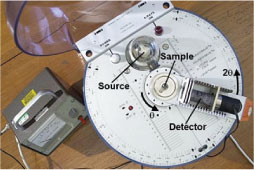
- Top view of a diffractometer (image)
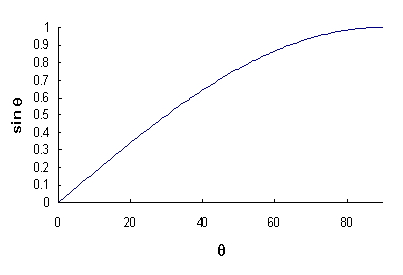
- Diagram of sin theta curve (image)
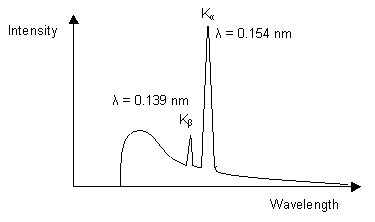
- Diagram of characteristsic X-ray emission from Cu target (image)
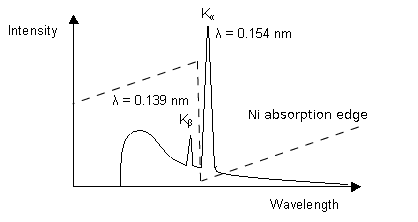
- Characteristic x-ray emission using an absorption filter (image)
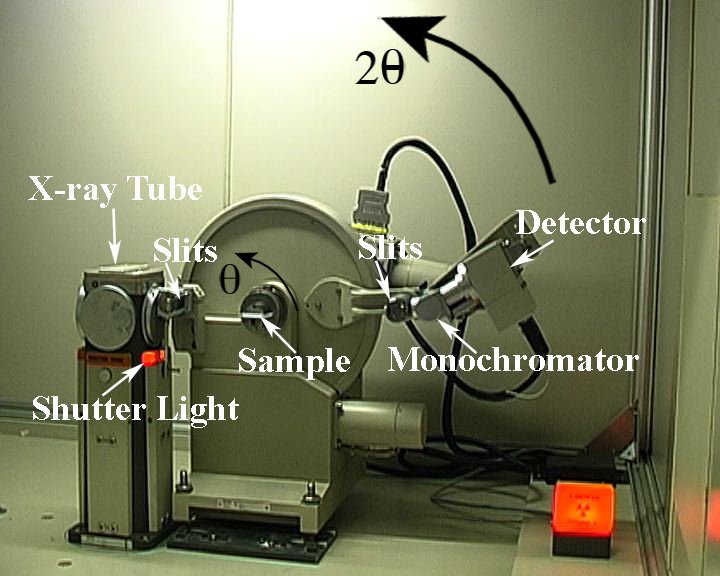
- Photograph of labelled x-ray diffractometer (image)
- Video showing how the sample moves through (~5 to 45°) while the detector scans though (~10 to 90°) (video)
- Video showing manual operation and the location of the first diffraction peak (video)
- Braggs's law (Flash)
- Simulation showing how the powder diffraction pattern of a simple face-centred cubic structure is influenced by changes in the cell parameter, atomic number, crystallite size (Flash)
- Simulation showing the change in relative intensities may indicate the orientation of the sample. (Flash)
- A simple purity check on hydroxyapatite (Flash)
- Identifying three possible phases in stabilised zirconias (Flash)
- Animation showing the relationship between single crystal and powder diffraction (Flash)
- Orientation measured by recording how a reflection is spread at constant 2 theta (Flash)
- Asymmetric reflections and work in transmission (Flash)
- Explanation of how an x-ray tube works (Flash)

© 2004-2012 University of Cambridge.