

Single crystal diffraction
The simplest way of demonstrating application of Bragg’s law is to diffract X-rays through a single crystal.
The simple teaching diffractometer in the photo below projects a beam of X-rays onto the crystal. The diffracted beam is collated through a narrow slit and passed through a nickel filter. The counter is a Geiger-Müller tube.
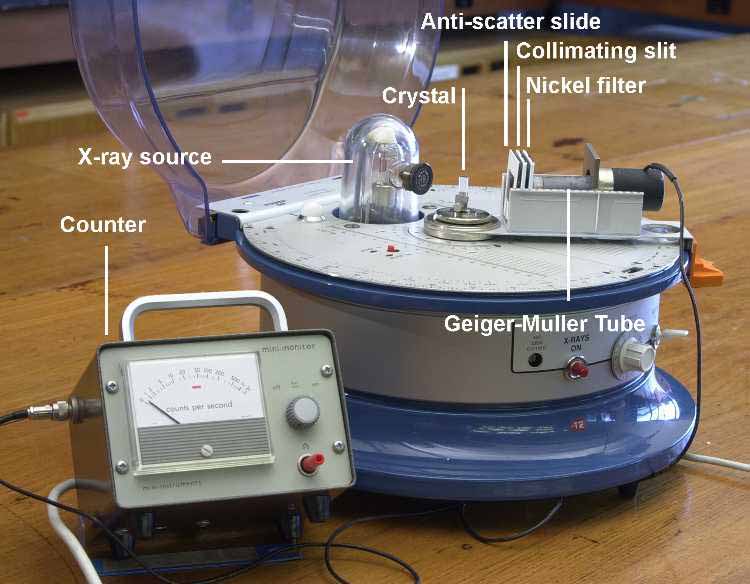
Diffractometer (Click on image to view larger version)
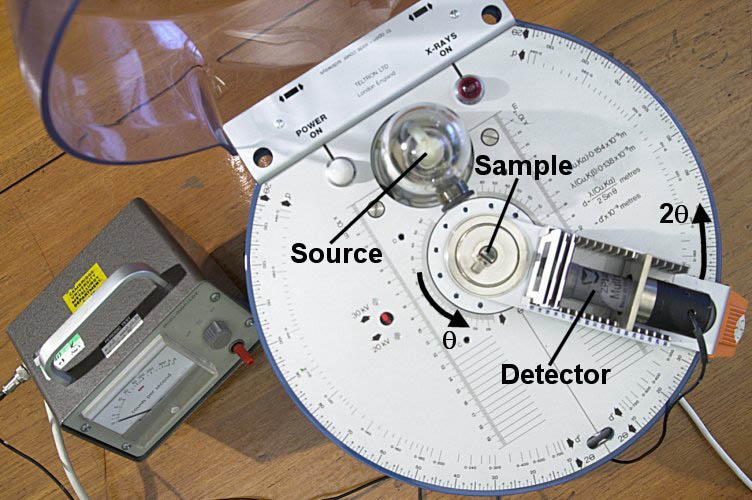
Top view of diffractometer (Click on image to view larger version)
The crystal used in this experiment is lithium fluoride. Assuming that the large flat face will be perpendicular to a particular crystallographic direction, this is set parallel to the line containing the source and detector at θ = 0. The gearing of the counter arm is such that, once set, the θ - 2θ relationship between the incident, transmitted and diffracted beams is maintained.
The video below shows manual operation and the location of the first diffraction peak. Watch the counter carefully.
Diffractometer experiment with lithium fluoride crystal
Using the 2θ value observed at a peak of intensity, the known wavelength λ for Cu Ka, = 1.54Å and the Bragg equation, a value for the plane spacing (d spacing) can be determined. If the peaks can be indexed, i.e. assigned to scattering from certain planes, then from simple geometry lattice parameters can be calculated. This is shown later in the TLP.