

Full Record for Micrograph 716
[209 KB]
View micrograph
.. in new window
View micrograph and record
.. in new window
You can also view and download the micrographs on Flickr

- Micrograph no
- 716
- Brief description
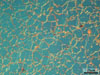
- IN718 nickel-based superalloy held for 3 hours at 850°C
- Keywords
- alloy
 , metal, nickel, nickel-based superalloy, niobium, precipitation
 - Categories
- Metal or alloy
- System
- Ni-X
- Composition
- Ni 53, Fe 19, Cr 18, Nb 5 (wt% approx) + small amounts of Ti, Mo, Co, Al
- Standard codes
- Reaction
- Processing
- Held for 3 hours at 850°C.
- Applications
- High temperature turbines.
- Sample preparation
- Grind on 240 grit SiC paper followed by polish on 9<span class="symbol">m</span>m, 6<span class="symbol">m</span>m, 1<span class="symbol">m</span>m, and OPS.
- Technique
- Reflected light microscopy, cross-polarised, with Nomarski filter
- Length bar
- 25 μm
- Further information
- IN718 is a nickel-based superalloy composed of approximately 53 wt% Ni, 19 wt% Fe, 18 wt% Cr, 5 wt% Nb, and small amounts of Ti, Mo, Co, and Al. The alloy has a number of distinct phases present in its microstructure. These are namely the matrix, g, and the precipitates, g', g'', and d.
The primary strengthening phase is g'' [1], the composition of which is Ni3Nb. It has a body-centred tetragonal structure, and forms semi-coherently as disc-shaped platelets within the g matrix, having three variants lying on the {100} planes. It is stable for over 10,000 hours at 600°C; however, above this temperature it decomposes to form g', Ni3Al (between 650°C and 850°C), and d, the same composition as g'' (between 750°C and 1000°C). It has been commented that, at large volume fractions and when it forms continuously along grain boundaries, d is detrimental to both strength and toughness [2].
The d phase that forms is more stable than the g'' phase, and has an orthorhombic structure. During cooling, d phase precipitates begin to form along the {111} planes in the matrix, nucleating at grain boundaries at approximately 1010°C.
The g' precipitates, of L12 structure, are seen within the g matrix when it has been depleted of niobium due to the formation of g'' and d.
The Time-Temperature-Transformation (TTT) diagram for IN718 shows that d precipitates at higher temperatures than the g'', and that over long periods of time both d and g' are more stable than g''.
The micrograph shows the microstructure after being held for 3 hours at 850°C, the volume fraction of d is greater than when held for shorter periods of time.
References:
[1] J. W. Brooks and P. J. Bridges. Metallurgical Stability of Inconel Alloy 718. Superalloys '88, pages 33 - 42, 1988.
[2] B. Gleeson. High-Temperature Corrosion of Metallic Alloys and Coatings: Volume II. In M. Schütze, editor, Corrosion and Environmental Degradation, volume 19 of Materials Science and Technology, chapter 5, pages 173 - 228. Wiley, 2000. - Contributor
- R Guest
- Organisation
- Rolls-Royce University Technology Centre, Department of Materials Science and Metallurgy, University of Cambridge
- Date
- 28/01/03
- Licence for re-use
 Attribution-NonCommercial-ShareAlike 4.0 International
- Related micrographs
- Micrograph 713: IN718 nickel-based superalloy held for 1 minute at 850°C (20 μm)
- Micrograph 714: IN718 nickel-based superalloy held for 20 minutes at 850°C (20 μm)
- Micrograph 715: IN718 nickel-based superalloy held for 1 hour at 850°C (25 μm)
- Micrograph 717: IN718 nickel-based superalloy held for 6 hours at 850°C (25 μm)
- Micrograph 718: IN718 nickel-based superalloy held for 24 hours at 850°C (25 μm)
- Micrograph 719: IN718 nickel-based superalloy held for 48 hours at 850°C (25 μm)
- Micrograph 720: IN718 nickel-based superalloy held for 72 hours at 850°C (25 μm)
)