

Lattice Planes and Miller Indices (all content)
Note: DoITPoMS Teaching and Learning Packages are intended to be used interactively at a computer! This print-friendly version of the TLP is provided for convenience, but does not display all the content of the TLP. For example, any video clips and answers to questions are missing. The formatting (page breaks, etc) of the printed version is unpredictable and highly dependent on your browser.
Contents
Main pages
Additional pages
Aims
On completion of this TLP you should:
- Understand the concept of a lattice plane;
- Be able to determine the Miller indices of a plane from its intercepts with the edges of the unit cell;
- Be able to visualise and draw a plane when given its Miller indices;
- Be aware of how knowledge of lattice planes and their Miller indices can help to understand other concepts in materials science.
Before you start
You should understand the concepts of a lattice, unit cell, crystal axes, vrystal system and the variations, primitive, FCC, BCC which make up the Bravais lattice.
You might also like to look at the TLP on Atomic Scale Structure of Materials.
You should understand the concepts of vectors and planes in mathematics.
Introduction
Miller Indices are a method of describing the orientation of a plane or set of planes within a lattice in relation to the unit cell. They were developed by William Hallowes Miller.
These indices are useful in understanding many phenomena in materials science, such as explaining the shapes of single crystals, the form of some materials' microstructure, the interpretation of X-ray diffraction patterns, and the movement of a dislocation, which may determine the mechanical properties of the material.
How to index a lattice plane
The next three animations take you through the basics of how to index a plane. Click "Start" to begin each animation, and then navigate through the pages using the buttons at the bottom right.
Parallel lattice planes
This animation explains the relationships between parallel planes and their indices. Click "Start" to begin and use the buttons at the bottom right to navigate through the pages.
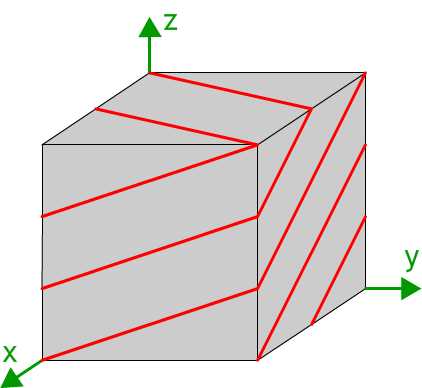
Lattice planes can be represented by showing the trace of the planes on the faces of one or more unit cells. The diagram shows the trace of the (23) planes on a cubic unit cell.
How to draw a lattice plane
Bracket Conventions
In crystallography there are conventions as to how the indices of planes and directions are written. When referring to a specific plane, "round" brackets are used:
(hkl)
When referring to a set of planes related by symmetry, then "curly" brackets are used:
{hkl}
These might be the (100) type planes in a cubic system, which are (100), (010), (001), (00),(00) and (00) . These planes all "look" the same and are related to each other by the symmetry elements present in a cube, hence their different indices depend only on the way the unit cell axes are defined. That is why it useful to consider the equivalent (010) set of planes.
Directions in the crystal can be labelled in a similar way. These are effectively vectors written in terms of multiples of the lattice vectors a, b, and c. They are written with "square" brackets:
[UVW]
A number of crystallographic directions can also be symmetrically equivalent, in which case a set of directions are written with "triangular" brackets:
<UVW>
Vectors and Planes
It may seem, after considering cubic systems, that any lattice plane (hkl) has a normal direction [hkl]. This is not always the case, as directions in a crystal are written in terms of the lattice vectors, which are not necessarily orthogonal, or of the same magnitude. A simple example is the case of in the (100) plane of a hexagonal system, where the direction [100] is actually at 120° (or 60° ) to the plane. The normal to the (100) plane in this case is [210]
VR rotating image
Weiss Zone Law
The Weiss zone law states that:
If the direction [UVW] lies in the plane (hkl), then:
hU + kV + lW = 0
In a cubic system this is exactly analogous to taking the scalar product of the direction and the plane normal, so that if they are perpendicular, the angle between them, θ, is 90° , then cosθ = 0, and the direction lies in the plane. Indeed, in a cubic system, the scalar product can be used to determine the angle between a direction and a plane.
However, the Weiss zone law is more general, and can be shown to work for all crystal systems, to determine if a direction lies in a plane.
From the Weiss zone law the following rule can be derived:
The direction, [UVW], of the intersection of (h1k1l1) and (h2k2l2) is given by:
U = k1l2 − k2l1
V = l1h2 − l2h1
W = h1k2 − h2k1
As it is derived from the Weiss zone law, this relation applies to all crystal systems, including those that are not orthogonal.
Examples of lattice planes
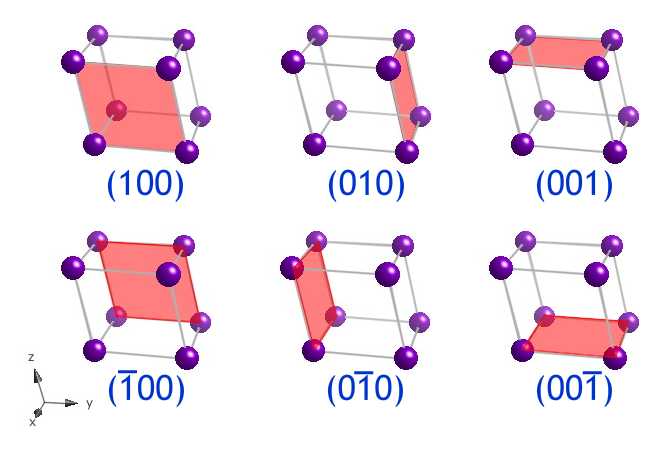
The (100), (010), (001), (00), (00) and (00) planes form the faces of the unit cell. Here, they are shown as the faces of a triclinic (a ≠ b ≠ c, α ≠ β ≠ γ) unit cell . Although in this image, the (100) and (00) planes are shown as the front and back of the unit cell, both indices refer to the same family of planes, as explained in the animation Parallel lattice planes. It should be noted that these six planes are not all symmetrically related, as they are in the cubic system.
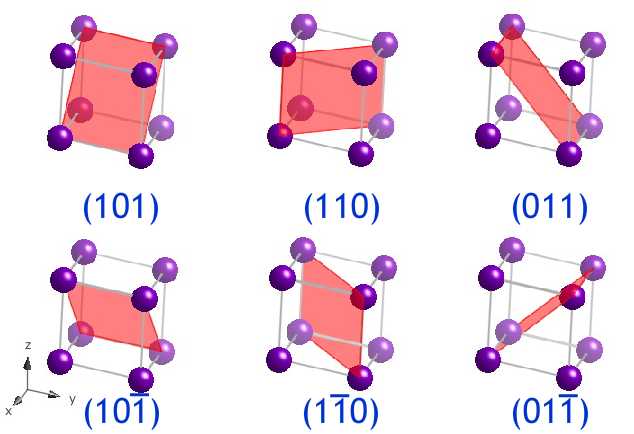
The (101), (110), (011), (10), (10) and (01) planes form the sections through the diagonals of the unit cell, along with those planes whose indices are the negative of these. In the image the planes are shown in a different triclinic unit cell.
The (111) type planes in a face centred cubic lattice are the close packed planes.
Click and drag on the image below to see how a close packed (111) plane intersects the fcc unit cell.
VR rotating image
Draw your own lattice planes
This simulation generates images of lattice planes. To see a plane, enter a set of Miller indices (each index between 6 and −6), the numbers separated by a semi-colon, then click "view" or press enter.
Practical Uses
An understanding of lattice planes is required to explain the form of many microstructural features of many materials. The faces of single crystals form on certain lattice planes, typically those with low indices.
In a similar way, the form of the microstructure in a polycrystalline material is strongly dependent on lattice planes. When a new phase of material forms, the surfaces tend to be aligned on low index planes, as with single crystals. When a new solid phase is formed in another solid, the interfaces occur on along the most energetically favourable planes, where the two lattices are most coherent. This leads to plate-like precipitates forming, at specific angles to each other.
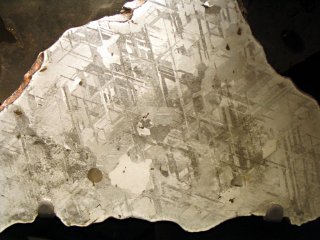
Section through an Fe-Ni meteorite showing plates at 60° to each other
DoITPoMS standard terms of use
One method of plastic deformation is by dislocation slip. Understanding lattice planes, and directions is essential to explain why dislocations move, combine and tangle in the observed way. More information can be obtained in the TLP - 'Slip in Single Crystals'
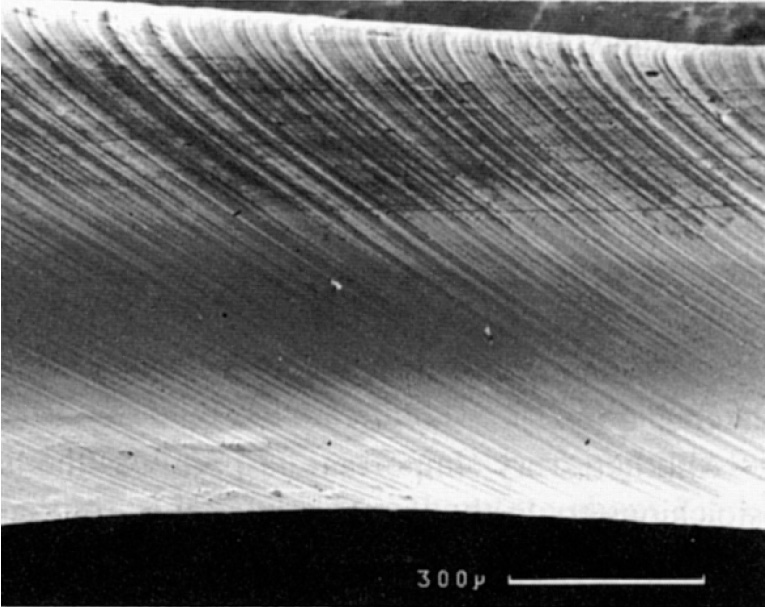
A scanning electron micrograph of a single crystal of cadmium
deforming by dislocation slip on 100 planes, forming steps
on the surface
DoITPoMS standard terms of use
Twinning is where a part of the crystal is "flipped" to form a mirror image of the rest of the crystal, reflected in a particular lattice plane. This can either occur in annealing, or as a mechanism of plastic deformation.
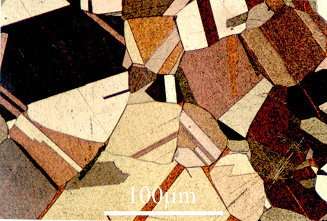
Annealing twins in brass (DoITPoMS micrograph library)
X-ray diffraction is a method of determining the crystal structure of a material. By interpreting the diffraction patterns as reflections from lattice planes in the material, the structure can be determined. More information can be obtained in the TLP - 'X-ray diffraction '
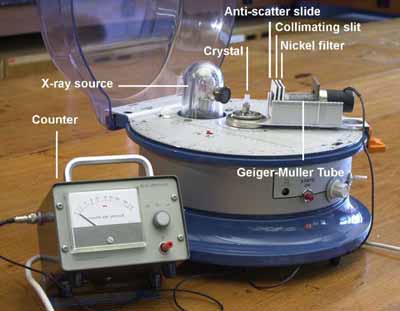
Apparatus for carrying out single crystal X-ray diffraction.
Worked examples
Example A
The figure below is a scanning electron micrograph of a niobium carbide dendrite in a Fe-34wt%Cr-5wt%Nb-4.5wt%C alloy. Niobium carbide has a face centred cubic lattice. The specimen has been deep-etched to remove the surrounding matrix chemically and reveal the dendrite. The dendrite has 3 sets of "arms" which are orthogonal to one another (one set pointing out of the plane of the image, the other two sets, to a good approximation, lying in the plane of the image), and each arm has a pyramidal shape at its end. It is known that the crystallographic directions along the dendrite arms correspond to the < 100 > lattice directions, and that the direction ab labelled on the micrograph is [10].
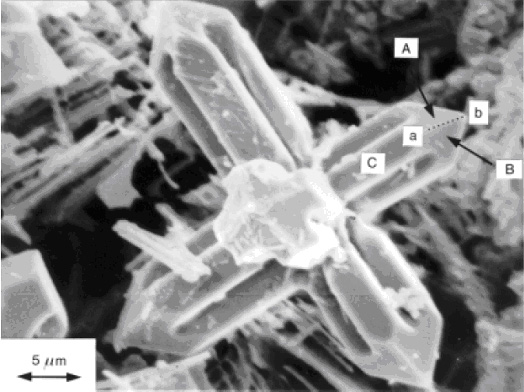
sourced from Dendritic Solidification
1) If point c (not shown) lies on the axis of this dendrite arm, what is the direction cb ? Index face C , marked on the micrograph.
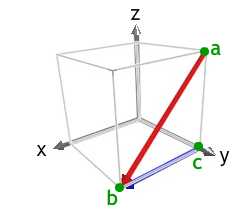
The diagram shows the [10] direction in red. The [100] direction is a < 100 > type direction that forms the observed acute angle with ab, and can be used as cb. Of the < 100 > type directions, we could also have used [00].
Using a right handed set of axes, we then have z-axis pointing out of the plane of the image, the x-axis pointing along the direction cb, and the y-axis pointing towards the top left of the image.
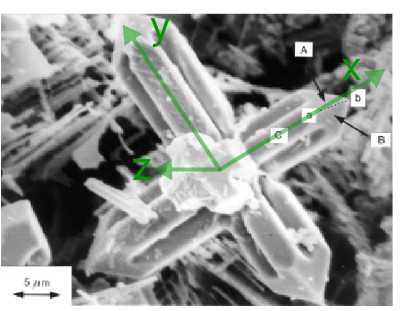
Face C must contain the direction cb, and its normal must point out of the plane of the image. Therefore face C is a (001) plane.
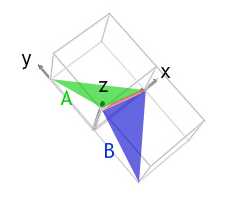
2) The four faces which lie at the end of each dendrite arm have normals which all make the same angle with the direction of the arm. Observing that faces A and B marked on the micrograph both contain the direction ab , and noting the general directions along which the normals to these faces point, index faces A and B .
Both faces A and B have normals pointing in the positive x and z directions, i.e. positive h and l indices. Face A has a positive k index, and face B has a negative k index.
The morphology of the ends of the arms is that of half an octahedron, suggesting that the faces are (111) type planes. This would make face A, in green, a (111) plane, and face B, in blue, a (11) plane. As required, they both contain the [10] direction, in red.
Example B
1) Work out the common direction between the (111) and (001) in a triclinic unit cell.
The relation derived from the Weiss zone law in the section Vectors and planes states that:
The direction, [UVW], of the intersection of (h1k1l1) and (h2k2l2) is given by:
U = k1l2 − k2l1
V = l1h2 − l2h1
W = h1k2 − h2k1
We can use this relation as it applies to all crystal systems, including the triclinic system that we are considering.
We have h1 = 1, k1 = 1, l1 = 1
and h2 = 0, k2 = 0, l2 = 1
Therefore
U = (1 × 1) - (0 × 1) = 1
V = (1 × 0) - (1 × 1) = −1
W = (1 × 0) - (0 × 1) = 0.
So the common direction is:
[10].
This is shown in the image below:
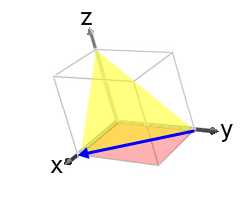
If we had defined the (001) plane as (h1k1l1) and the (110) plane as (h2k2l2) then the resulting direction would have been, [10] i.e. anti-parallel to [10].
2) Use the Weiss zone law to show that the direction [10] lies in the (111) plane.
We have U = 1, V = −1, W = 0,
and h = 1, k = 1, l = 1.
hU + kV + lW = (1 × 1) + (1 × −1) + (1 × 0) = 0
Therefore the direction [10] lies in the plane (111).
Summary
Miller Indices are the convention used to label lattice planes. This mathematical description allows us to define accurately, planes within a crystal, and quantitatively analyse many problems in materials science.
Questions
Game: Identify the planes
Quick questions
You should be able to answer these questions without too much difficulty after studying this TLP. If not, then you should go through it again!
-
Which one of the following statements about the (4) and (21) planes is false?
-
Does the [12] direction lie in the (30) plane?
-
When writing the index for a set of symmetrically related planes, which type of brackets should be used?
-
Which of the <110> type directions lie in the (112) plane?
-
What is the common direction between the (1) and (33) planes?
-
Which set of planes in a cubic-close-packed structure (such as copper) is close packed?
Open-ended questions
The following questions are not provided with answers, but intended to provide food for thought and points for further discussion with other students and teachers.
-
Practice sketching some lattice planes. Make sure you can draw the {100}, {110} and {111} type planes in a cubic system.
-
Draw the trace of all the (21) planes intersecting a block 2 × 2 × 2 block of orthorhombic (a ≠ b ≠ c, α = β = γ = 90°) unit cells.
-
Sketch the arrangement of the lattice points on a {111} type plane in a face centred cubic lattice. Do the same for a {110} type plane in a body centred cubic lattice. Compare your drawings. Why do you think the {110} type planes are often described as the "most close packed" planes in bcc?
Going further
Books
[1] D. McKie and C. McKie, Crystalline Solids , Thomas Nelson and Sons, 1974.
A very comprehensive crystallography text.
[2] C. Hammond, The Basics of Crystallography and Diffraction , Oxford, 2001.
Chapter 5 covers lattice planes and directions. The rest of the book gives an introduction to crystallography and diffraction in general.
[3] B.D. Cullity, Elements of X-Ray Diffraction , Prentice Hall, 2003.
Covers X-Ray diffraction in detail. Chapter 2 covers the crystallography required for this.
[4] C. Kittel, Introduction to Solid State Physics, John Wiley and Sons, 2004.
Chapter 1 covers crystallography. The book then goes on to cover a wide range of more advanced solid state science.
Cómo indexar un plano de una red
Las siguientes tres animaciones muestran los fundamentos básicos para calcular los parámetros del red. Haz click en "Inicio" para que comience cada animación, y luego navega a través de las páginas usando los botones situados en la parte inferior derecha.
如何标注一个晶格面
以下的三个动画 课程将让你了解关于标注晶格面的基本知识。点击‘开始’来开始每个动画课程,然后用右下角的按钮来进入下一页。
Как обозначать плоскость кристаллической решётки
Следующие три анимации покажут основы того, как обозначать плоскость. Нажмите кнопку "Пуск", чтобы запустить каждую из анимаций, а затем управляйте анимацией с помощью кнопок, расположенных в правом нижнем углу.
Academic consultant: Noel Rutter (University of Cambridge)
Content development: Peter Marchment
Photography and video: Brian Barber and Carol Best
Web development: David Brook and Lianne Sallows
Translation: Jing Qiu, Kansong Chen, Ana Tabalan-Bailey, Marta Sanchez, Juan Vilatela
This DoITPoMS TLp was funded by the UK Centre for Materials Education and the Department of Materials Science and Metallurgy, University of Cambridge.
Additional support for the development of this TLP came from the Worshipful Company of Armourers and Brasiers'