

Alkaline/manganese oxide batteries
This primary battery system has a higher capacity than the zinc/carbon cell. It has a very good performance at high discharge rates and continuous discharge and at low temperatures. The first modern alkaline cell was developed in the 1960s and by 1970 it was produced all over the world. Currently over 15 billion alkaline cells are used worldwide each year.

Chemistry
The active materials used are the same as in the Leclanché cell – zinc and manganese dioxide. However the electrolyte is potassium hydroxide, which is very conductive, resulting in low internal impedance for the cell. This time the zinc anode does not form the container; it is in the form of a powder instead, giving a large surface area.
The following half-cell reactions take place inside the cell:
At the anode: Zn + 2OH– → Zn(OH)2 + 2e–
Zn(OH)2 + 2OH– → [Zn(OH)4]2–
At the cathode: 2MnO2 + H2O + 2e– → Mn2O3 + 2OH–
For full discharge: MnO2 + 2H2O + 2e– → Mn(OH)2 + 2OH–
Overall: Zn + 2MnO2 → ZnO + Mn2O3
For full discharge: Zn + MnO2 + 2H2O → Mn(OH)2+ Zn(OH)2
It is not possible to describe the cathodic reaction on discharge in a simple unambiguous way, despite a lot of research. In fact the discharge curve has two fairly distinct sections corresponding to change in the oxidation state of Mn from +4 to +3 and then to +2 during the reduction of MnO2. The reality is more complicated than described in the two reactions shown above.
Construction
This cell is “inside out” compared to the Leclanché cell - the manganese dioxide cathode is external to the zinc anode, giving better diffusion properties, and lower internal resistance.
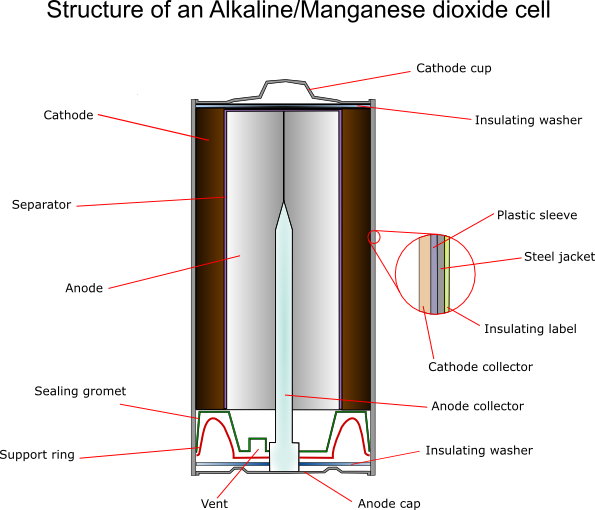
Cathode
For an alkaline cell electrochemically produced MnO2 must be used. The ore rhodochrosite (MnCO3) is dissolved in sulphuric acid, and electrolysis is carried out under carefully controlled conditions using titanium, lead alloys or carbon for the electrode onto which the oxide is deposited. This gives the highest possible purity, typically 92 ± 0.3%.
The cathode itself also contains around 10% graphite – more for more powerful batteries. A typical composition would be:
70% MnO2 (of which 10% is water);
~10% graphite;
1-2% acetylene black;
Balance: binding agents and electrolyte.
Zinc Anode
The zinc must be very pure (99.85 – 99.90%) and is produced by electroplating or distilling. Very small amounts of lead are sometimes added to help prevent corrosion (usually ~0.05%) The zinc is powdered by discharging a small stream of molten zinc into a jet of air “atomising” it. The powder contains particles between 0.0075 and 0.8 mm.
There are two methods of formation of the anodes from the powder:
- Gelled anodes: These contain around 76% Zn, 7% mercury, 6% sodium carboxymethyl cellulose and 11% KOH solution. It is extruded into the cell, as the viscosity is high. In very small cells, NaOH is added to reduce creepage around the seal area. However this mixture is not ideal: it does not fully utilise the zinc at high current densities. Two-phase anodes have therefore been developed, consisting of a clear gel phase and a more compact zinc-powder gel phase, which enables 90% zinc usage.
- Porous anodes: The zinc powder is wetted with mercury and cold pressed, welding the particles together. The porosity can be controlled by materials such as NH4Cl or plastic binders if required, which can be removed later. These anodes can carry very high currents.
Separators
These cells usually use “macro porous” separators. These are made from woven or felted materials.