

Hookean elasticity
For many materials loaded in uniaxial tension, the tensile stress on the material, σ, is directly proportional to the tensile strain , ε.
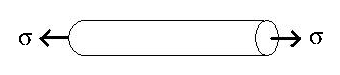
A sample loaded in uniaxial tension
The linear relationship between stress and strain is known as Hooke's Law,
σ ∝ ε
The constant of proportionality in this equation for simple tension is the Young Modulus of the material, E:
\[E = \frac{\sigma }{\varepsilon }\]
The Young Modulus of a material has values ranging from approx. 0.01 GPa for rubbers to approx. 1000 GPa for diamond.
Hooke's Law further states that the stress response of a material is independent of time and that the strain of a material disappears completely on removal of the applied stress (i.e. a Hookean material shows elastic deformation ).
This leads to a linear stress-strain curve with a gradient of E. Loading and unloading occur along the same curve.
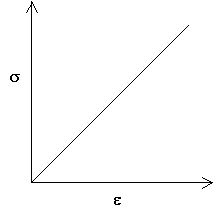
A stress-strain curve for a Hookean material
Most materials are Hookean only at small strains (typically less than 1%). Metals, for which fully elastic behaviour is only for very small strains (typically <0.2%), show Hookean behaviour. In this region, the extension is usually both linear and recoverable. At larger strains, extension is non-Hookean (i.e. either non-recoverable, or non-linear, or both).
Although many materials used in engineering applications show Hookean behaviour, only a few biomaterials approximate to it (wood and bone being the two most common). Many biomaterials exhibit a J-shaped stress-strain curve, but firstly, we shall consider the S-shaped stress-strain curve seen in rubbery materials.