

Yield criteria for metals
A yield criterion is a hypothesis defining the limit of elasticity in a material and the onset of plastic deformation under any possible combination of stresses.
There are several possible yield criteria. We will introduce two types here relevant to the description of yield in metals.
To help understanding of combinations of stresses, it is useful to introduce the idea of principal stress space. The orthogonal principal stress axes are not necessarily related to orthogonal crystal axes.
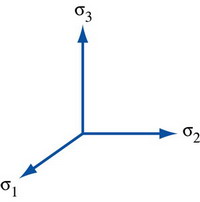
Using this construction, any stress can be plotted as a point in 3D stress space.
For example, the uniaxial stress \(\left( {\begin{array}{*{20}{c}} \sigma &0&0\\ 0&0&0\\ 0&0&0 \end{array}} \right)\) where σ1 = σ; σ2 = σ3= 0, plots as a point on the σ1axis.
A purely hydrostatic stress σ1 = σ2 = σ3=σH will lie along the vector [111] in principal stress space. For any point on this line, there can be no yielding, since in metals, it is found experimentally that hydrostatic stress does not induce plastic deformation (see hydrostatic and deviatoric components).
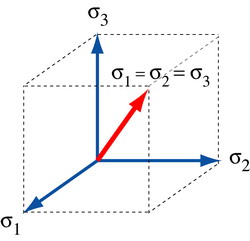 The 'hydrostatic line'
We know from uniaxial tension experiments, that if σ1 = Y,
σ2 = σ3 = 0
where Y is a uniaxial stress, then yielding will
occur.
Therefore, there must be a surface, which surrounds the hydrostatic line and passes through (Y, 0, 0) that defines the boundary between elastic and plastic behaviour. This surface will define a yield criterion. Such a surface has also to pass through the points (0, Y, 0), (0, 0, Y), (–Y, 0, 0) (0, –Y, 0) and (0, 0, –Y).
The plane defined by the three points (Y, 0, 0), (0, Y, 0) and (0, 0, Y) is parallel to the plane defined by the three points (–Y, 0, 0) (0, –Y, 0) and (0, 0, –Y).
The simplest shape for a yield criterion satisfying these requirements is a cylinder of appropriate radius with an axis along the hydrostatic line. This can be described by an equation of the form:
\[{\left( {{\sigma _1} - {\sigma _2}} \right)^2} + {\left( {{\sigma _2} - {\sigma _3}} \right)^2} + {\left( {{\sigma _3} - {\sigma _1}} \right)^2} = {\rm{constant}}\]
From above, if, σ1 = Y, σ2 = σ3 = 0, then the constant is given by 2Y2. This is the von Mises Yield Criterion.
We can also define a yield stress in terms of a pure shear, k. A pure shear stress can be represented in a Mohr’s Circle, as follows:
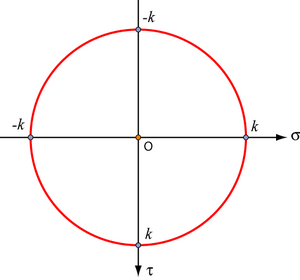
Referred to principal stress space, we have σ1 = k, σ2 = –k, σ3 = 0.
The von Mises criterion can therefore be expressed as:
\[2{Y^2} = 6{k^2}{\rm{ }} \Rightarrow {\rm{ }}Y = k\sqrt 3 \]
A mathematically simpler criterion which satisfies the requirements for the yield surface having to pass through (Y, 0, 0), (0, Y, 0) and (0, 0, Y) is the Tresca Criterion.
If we suppose σ1 > σ2 > σ3, then the largest difference between principal stresses is given by (σ1 – σ3).
If yielding occurs when σ1 = Y, σ2 = σ3 = 0, then (σ1 – σ3) = Y.
For yield in pure shear at some shear stress k, when referred to the principal stress state we could have
\[{\sigma _1} = k,{\rm{ }}{\sigma _2} = 0,{\rm{ }}{\sigma _3} = - k{\rm{ }} \Rightarrow {\rm{ }}Y = 2k\]
The Tresca criterion is (σ1 – σ3) = Y = 2k.
Viewed down the hydrostatic line, the two criteria appear as:
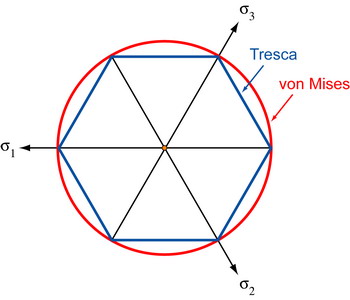
For plane stress, let the principal stresses be σ1
and σ2, with
σ3 = 0.
The yield surfaces for the Tresca yield criterion and the von Mises yield criterion in plane stress are shown below:
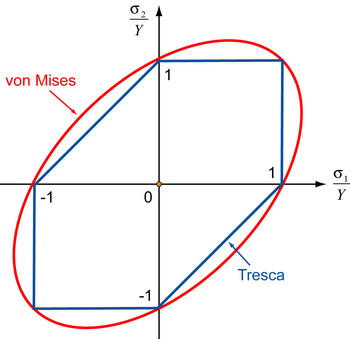
The Tresca yield surface is an irregular hexagon and the von Mises yield surface is an ellipse. The ratio of the length of the major and minor axes of this ellipse is \(\sqrt 3 {\rm{ :1}}\). Click here for a derivation of this result.
Experiments suggest that the von Mises yield criterion is the one which provides better agreement with observed behaviour than the Tresca yield criterion. However, the Tresca yield criterion is still used because of its mathematical simplicity.

 Example Problem 1: Yield criteria for metals