

Optimisation of Materials Properties in Living Systems (all content)
Note: DoITPoMS Teaching and Learning Packages are intended to be used interactively at a computer! This print-friendly version of the TLP is provided for convenience, but does not display all the content of the TLP. For example, any video clips and answers to questions are missing. The formatting (page breaks, etc) of the printed version is unpredictable and highly dependent on your browser.
Contents
Aims
On completion of this TLP you should:
- Understand how materials-selection maps can be used to choose a suitable material for an engineering application.
- Understand the use of merit indices in relation to materials-selection maps and be able to derive common examples.
- Appreciate that biomaterials have different properties to man-made materials and can outperform common engineering materials for certain applications.
- Be aware of why some biomaterials have developed specific properties.
Before you start
- You should be familiar with mechanical testing.
- You should be familiar with Young’s modulus E, strength σf, density ρ and toughness (fracture energy Gc and fracture toughness Kc).
- You should be familiar with brittle and ductile fracture.
- You should understand beam bending and beam stiffness with regard to beam deflections during cantilever bending.
Introduction
As a result of evolutionary selection, biomaterials are well adapted for their functions, as will be discovered in this TLP. (Note. In this TLP the term biomaterials refers to the materials of living systems and not man-made materials with biomedical applications). Unlike man-made materials, a limited range of ingredients (never metal) is used to display a wide range of properties. Charles Darwin himself noted that, ‘As a general principle, natural selection is continually trying to economise every part of the organisation’. For instance, tendons and muscle are made of collagen, as are the cornea, skin and blood vessels. Whereas the manufacturing process determines engineering materials’ properties, in biomaterials the structure’s age and environment affect the materials properties, leading to variation in the properties of a specific biomaterial. Biomaterials tend to be strong, anisotropic and are usually composite materials. Biomaterials have many advantages, as they are sustainable, recyclable and biodegradable, unlike most common engineering materials. However, the hierarchical structure makes replicating the structure of biomaterials complicated and their use is restricted to ambient-temperature applications.
Similarly to engineering materials, biomaterials are classed into the following groups corresponding to shared characteristics:
- Natural ceramics and ceramic composites (e.g. enamel, bone, shell, antler).
- Natural polymers and polymer composites (e.g. proteins such as silk and polysaccharides such as cellulose).
- Natural elastomers (e.g. skin, artery, cartilage).
- Natural cellular materials (e.g. wood, cancellous bone, cork).
This TLP shows how materials-selection maps can be used to compare biomaterials with common engineering materials, looking specifically at using these maps in conjunction with merit indices. Four of the most commonly used materials-selection maps will be studied:
- Young’s modulus against density,
- Strength against density,
- Young’s modulus against strength,
- Toughness against Young’s modulus.
These are particularly important for choosing the most suitable material for a specific application, and looking at the interesting properties specific to certain biomaterials such as viscid silk found as the capture threads in spiders’ webs.
Young´s Modulus - Density selection map
Imagine a material is needed to build an aircraft panel, this will be subject to bending moments, and so the deflection that occurs must be minimised. It is also necessary to keep the mass of the aircraft low and so the density of the material should also be minimised. It is important to find a balance between these different material properties in order to find the most suitable material for the application. This can be achieved by finding the appropriate merit index and comparing its value for different materials.
Consider the bending of a flat panel of length L, width w and height h, subject to an end load F. The engineering application sets the size of the panel (L and w) and the load it must support (F). Thus L, w and F are not variables in our analysis. On the other hand, the height h is a variable in that it is not of direct interest: it may be equally valid to use a thin panel of a dense material, or a thick panel of a light material. The bending moment M at the root of the beam is given by M = FL, and this decreases to zero at the end of the beam.

Cantilever bending
The second moment of area I (derivation) for such a panel is given by:
$$I = {{w{h^3}} \over {12}}$$
Assuming only simple bending occurs (and the panel only deflects as shown in the picture, i.e. not forming any complex shapes), the deflection of the end of the panel \(\delta \) is given by:
$$\delta = {{F{L^3}} \over {3EI}}$$
The mass m of the beam is given by:
$$m = Lwh\rho $$
Hence, having the height h as the free parameter, and combining the previous two equations by eliminating t gives:

So to obtain the minimum deflection for a panel of free thickness and given mass, or equivalently the minimum mass for a given deflection, \({{{E^{1/3}}} \over \rho }\) must be maximised. This is an example of a merit index. As the other values in the equation are engineering parameters, the material chosen will not alter these values, and so they are excluded from the merit index, which is based only on materials parameters.
Low density is clearly very important for this merit index and hence wood is favoured for applications requiring a flat sheet in bending as it has a low density due to the large voids contained in the structure.
This merit index can now be represented on a materials-selection map, allowing easy comparison of the different materials available for this application. Most materials-selection maps, such as the one shown, are plotted on logarithmic scales. This allows a given value of the index to be indicated by a straight line:
From the equation for deflection, \({{{E^{1/3}}} \over \rho }\) = \(k\), where k is a constant.
Hence \(\log (E) = 3\log (\rho ) + {k^{'}}\) where \({k^{'}}\) is a different constant \(3\log (k)\)
On the selection map shown below, moving a line of the correct gradient as far as possible to the top and the left (and hence maximising E and minimising \(\rho \)) will give materials with the best value of the merit index. Try this by moving the line for the appropriate merit index on the following materials-selection maps for engineering alloys and biomaterials.
Other important merit indices used in relation to this chart are:
- $${E \over \rho }$$ relating to the minimum deflection achievable on loading a strut or tie in tension with the cross section as a free parameter, or the minimum deflection achievable on bending a beam with the width as a free parameter,
- $${{{E^{1/2}}} \over \rho }$$ relating to the minimum deflection achievable on bending a beam with the cross sectional area (of fixed shape) as a free parameter.
It can be seen from the materials-selection chart that aluminium alloys behave well in bending, and hence are used in aeroplanes. Wood is also an impressive material for this application, and it was used in the past in the Mosquito aeroplane from World War II:

Mosquito aeroplane
Wood is able to resist bending with a low mass, as it has evolved so that trees will not bend far in strong winds or under their own weight. To maintain an array of leaves catching light for photosynthesis, tree trunks and branches have developed the materials properties of low density and relatively high Young’s modulus.
Strength - Density selection map
Strength σf is the maximum stress which a material can support before failure, where failure is usually taken to be the end of the purely elastic regime. For ductile materials σf is the stress for the onset of plastic (irreversible) flow. Brittle materials break before they yield, so σf is the stress for the onset of brittle fracture.
Merit indices used in conjunction with these maps are:
\({{{\sigma _f}} \over \rho }\), used to find the material giving the strongest strut or tie in tension, for a given mass with the cross-sectional area of the beam as the free parameter.
\({{{\sigma _f}^{2/3}} \over \rho } \), used to find the material giving the strongest beam (i.e. that supporting the largest bending moment before the onset of plastic yielding or other failure on the surface of the beam) of a given mass, on bending a beam with a specified cross-sectional shape but free cross-sectional area.

The merit index \( {{{\sigma _f}^{1/2}} \over \rho } \) for maximising the strength of a beam under a bending load for a given mass, with a specified beam width, and unspecified height will now be derived:
Consider a beam of length L, width w and height h, subject to an end load F. The second moment of area is:
$$I = {{w{h^3}} \over {12}}$$
and the mass of the beam is:
$$m = whL\rho $$
which can be rearranged in terms of the free parameter h as:
$$h = {m \over {wL\rho }}$$
For beam bending, \(M = \kappa EI\) and \(\kappa = \)\({{{\sigma _f}} \over {Eh}}\) (Derivation), therefore,
$$M = {{{\sigma _f}I} \over h}$$
Substituting in the value for I gives:
$$M = {{{\sigma _f}w{h^2}} \over {12}}$$
To find the desired merit index the free parameter h can then be eliminated from the equation giving:
$$M = {{{m^2}} \over {12w{L^2}}}\left( {{{{\sigma _f}} \over {{\rho ^2}}}} \right)$$
Hence maximising \({{{\sigma _f}} \over {{\rho ^2}}}\) or \({{{\sigma _f}^{1/2}} \over \rho }\) by moving the merit index line towards the top and the left of the above materials-selection map gives the material that is strongest in bending a beam of a given mass (given the conditions of fixed beam width and variable height).
Young´s Modulus - Strength selection map
The Young’s modulus – strength materials-selection map is used in conjunction with merit indices relating to elastic deformation and elastic energy storage. For simple tensile loading, to assess differences in maximum recoverable elastic deformation, the merit index \({{{\sigma _f}} \over E}\) is used. To compare maximum elastic strain energy per unit volume, the merit index is \({{\sigma _f^2} \over E}\) used, and for the maximum elastic strain energy per unit mass, the merit index \({{\sigma _f^2} \over {E\rho }}\) is used.
To derive the merit index \({{{\sigma _f}} \over E}\) , the cross-sectional shape of the tie in tension of the structure need not be considered, and engineering parameters are not involved in the derivation, making this a simple merit index to derive as follows:
From the definition of Young’s modulus, while the material is behaving elastically:
$$\sigma = E\varepsilon $$
Therefore the maximum elastic strain (i.e. the deformation at the yield point) depends simply on the maximum elastic stress (i.e. stress before failure) which is the strength σf :
\(\varepsilon = {{{\sigma _f}} \over E}\)
So to find the material with the greatest maximum recoverable deformation, the merit index \({{{\sigma _f}} \over E}\) is maximised using the materials-selection chart shown. This involves moving the merit index line towards the bottom and the right of the map. From doing this it can be seen that cartilage, viscid silk, resilin and skin have good values of this merit index.
Cartilage is found on the end of bone in joints and so it is important that it is flexible while not being permanently deformed or breaking when the joints bend. The same argument applies to skin, it would be rather gruesome if our skin split open every time we bent our elbow! The merit index \({{{\sigma _f}} \over E}\) is also used to find the best material for elastic hinges. This explains resilin’s high value of the merit index as it is found in insect wing hinges. The insect only has to pull the wing back and it will then be pulled forward by the elasticity of the hinge (with resilin, this is particularly efficient as it has a very low absorption of energy on elastic bending to and fro - i.e. resilin has a high coefficient of restitution or resilience). This is discussed further in the Elasticity in Biological Materials teaching and learning package.
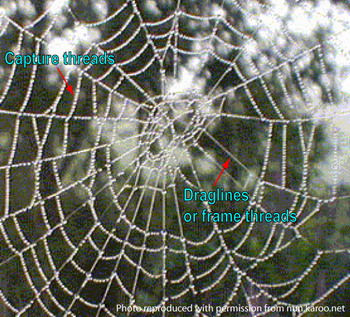
Spider's web
Viscid silk has a high value of this merit index, being able to stretch up to three times its own length. Viscid silk makes up capture threads in a spider’s web: it must entangle flies giving an advantage in a high value. Viscid silk also needs to absorb the kinetic energy of the fly, corresponding to a high \({{{\sigma _f}} \over E}\) value. This is discussed further in the Elasticity in Biological Materials teaching and learning package, where it is noted that viscid silk has (in contrast to resilin) a low coefficient of restitution - this reduces the elastic energy returned to the fly.
Toughness - Young´s Modulus selection map
A material's resistence to cracking can be characterised in various ways, each relevant in particular circumstances:
- Toughness, GC, to maximise the impact resistance of the material used.
- Fracture toughness, Kc [=(EGC)1/2], to maximise the resistance to cracking of a material under load.
- \({\left( {{{{G_C}} \over E}} \right)^{1/2}}\) to maximise the elastic stretching of a material before the onset of brittle facture (cracking).
These merit indices are easily used with the Toughness-Young's Modulus materials-selection map.
The following method is used to derive the merit index \({\left( {{{{G_C}} \over E}} \right)^{1/2}}\). Consider stretching a material: the strain (or amount of stretching) of the material is given by the equation:
$$\varepsilon = {\sigma \over E}$$
The amount of stretching at the fracture point is:
$${\varepsilon _{\max }} = {{{\sigma _f}} \over E}$$
The stress to give fracture is given by the formula:
$${\sigma _f} = {\left( {{{{G_C}E} \over {\pi c}}} \right)^{1/2}}$$, where 2c is the crack length. (Derivation)
Thus:
\({\varepsilon _{\max }}\) = \({\left( {{{{G_C}E} \over {\pi c}}} \right)^{1/2}}\)\(\left( {{1 \over E}} \right)\) or \({\varepsilon _{\max }}\) = \({\left( {{1 \over {\pi c}}} \right)^{1/2}}{\left( {{{{G_C}} \over E}} \right)^{1/2}}\)
Therefore, in order to maximise the stretching of the material without failure, \({\left( {{{{G_C}} \over E}} \right)^{1/2}}\) must be maximised by moving the line corresponding to the merit index towards the top and the left of the materials-selection map above.
Try this for yourself and you will see that skin is the best biomaterial. Skin clearly needs this property, as it is continually being stretched in normal life. Different materials show good values for other merit indices: for instance, antler has a high value of toughness, GC. Antler is a composite material made of the ceramic hydroxyapatite and the polymer collagen, similarly to compact bone, giving it a high toughness. This enables stags to fight with their antlers, generating large impacts, without the antlers cracking. Stags fight in this way, called rutting, as a mating ritual to prove to females that they are the strongest stag and hence will produce the healthiest offspring. Antlers are shed and re-grown each year, and are sometimes found in furniture and artwork.
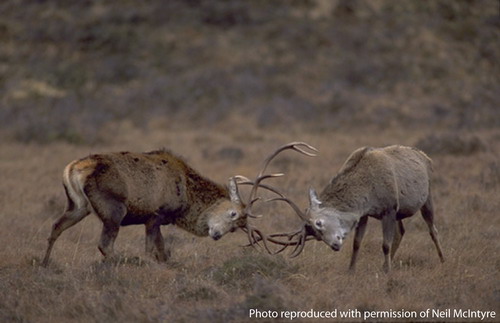
Stags rutting.
Wood tested parallel to its grain (i.e. for cracks in the plane perpendicular to the grain) has the highest value of fracture toughness, Kc, for a biomaterial. It is a fibre composite made up of cellulose fibres in a lignin matrix. (This is discussed in The Structure and Mechanical Behaviour of Wood teaching and learning package). Trees could easily get small cracks in them and it is important that the trunk and branches do not fail in wind or under their own weight. The composite structure makes wood very anisotropic: its Kc in splitting mode (cracks parallel to grain) is very low.
Comparison of engineering materials and biomaterials
Sometimes it is important to look at more than one materials-selection map and merit index. For instance on comparison of the use of steel and aluminium as a material for aircraft, the merit index \({{{\sigma _f}} \over \rho }\) for loading a tie in tension shows that steel outperforms aluminium in this context. (Of course, as shown on the maps, both steels and aluminium alloys are families of materials with broad ranges of properties.) In fact, steel wires were used by the Wright brothers and in World War I biplanes:

Wright brother's aeroplane.
However aluminium performs well under the elastic bending of beams and flat panels, having a greater value than steel for the merit indices \({{{E^{1/2}}} \over \rho }\) and \({{{E^{1/3}}} \over \rho }\) , and hence aluminium alloys are now used to make major parts of aircraft whereas steel is not.
It may also be important for a material to have high values of more than one merit index. For example a material may be wanted that will be tough and also have a good value of Young’s modulus for a low relative cost per unit volume:

Looking at the materials-selection maps, good materials that fit these requirements are lead alloys, zinc (Zn) alloys and steels.
Consider a comparison of biomaterials to man-made materials, specifically commonly used engineering materials such as steel, aluminium alloys, titanium alloys, alumina and polyethylene. It can be seen that alumina, aluminium alloys, steel and titanium alloys perform quite well in terms of Young’s modulus – density related merit indices. This is due to their high values of Young’s modulus, despite their high densities. Polyethylene compares poorly with biomaterials in this respect however, due to its low value of Young’s modulus.
Alumina, aluminium alloys, steel and titanium alloys are more commonly used in engineering applications than biomaterials. This is despite biomaterials, particularly types of wood, outperforming these materials for some of the merit indices on this materials-selection map. It is important to note that the distinction between the materials of living systems and conventional engineering materials is not absolute. Wood is more widely used than these engineering materials for low-tech applications, and is in fact the world’s principal material for building. This makes wood among the most common and important structural engineering materials. Although wood has only a quarter the strength of steel, it has four times the specific strength (\({{{\sigma _f}} \over \rho }\) ) and is renewable, recyclable and requires only a low energy input to make. This makes the price of wood 1/60th per tonne the price of steel with 109 tonnes being used annually worldwide, which is comparable to the amount of iron and steel used globally. Wood has many uses such as the hubs and rims of traditional wheels (for which elm and oak, respectively, are used), longbows (made from yew) and cricket bats (made of willow). However wood is strongly anisotropic, highly susceptible to water damage and unable survive and to perform at high temperatures. There is also a large amount of variability in wood, as different growing conditions for trees of the same species lead to differing mechanical properties. It is possible to limit the anisotropy of wood by using plywood, which involves creating layers of wood with orthogonal “grains” (orientation of the tracheid/ fibre cell structure). The other limitations cannot so easily be overcome, limiting wood’s use as an engineering material with light specifications. (This is discussed in The Structure and Mechanical Behaviour of Wood teaching and learning package).
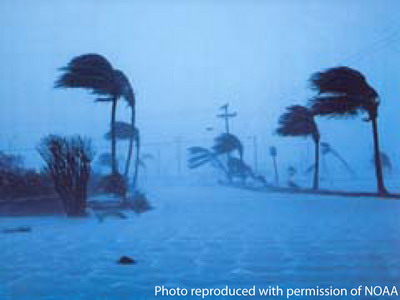
Palm trees can survive very high winds, behaving well under bending moments.
Looking at the strength – density materials selection chart:
Alumina clearly outperforms biomaterials when loading a tie under tension, it has a high value of the merit index \({{{\sigma _f}} \over \rho }\) and performs well for all merit indices shown on the above map. But the applicability of alumina is likely to be limited by its brittleness (low Kc) and the difficulty of forming into components. Aluminium alloys, titanium alloys, and particularly steel and polyethylene, have merit indices inferior to those of many biomaterials. This is due to their greater density and in polyethylene’s case relatively low strength. This doesn’t necessarily mean that biomaterials will be chosen over common engineering materials however. Other factors to be considered in choosing a material for an engineering application once merit indices have been compared include:
- cost
- resistance to creep
- ease of manufacture
- availability
- resistance to corrosion
- ability to function at a required temperature
- energy efficiency
Only when all these factors along with the merit indices and materials-selection maps have been considered, can the best material for a particular application be found. Materials-selection maps and merit indices can be used to compare broad ranges of different materials to discover roughly which few materials are most suitable. Each material would then need to be assessed in more detail to discover which material is truly best for a specific use.
Summary
- In this TLP you have learnt how and why to use materials-selection maps, and about the common merit indices used in conjunction with these maps. Simple merit indices have been derived and used to analyse the difference in applicability of various materials.
- Many biomaterials show interesting properties and can outperform common engineering materials. You will have discovered why certain biomaterials have evolved to show these properties and you will be able to think about why other biomaterials may have certain properties.
- You should now be aware of how to choose a shortlist of materials suitable for a specific application, and be able to decide which material out of a selection is most suited to a particular purpose. However, you should also be aware of the limitations of merit indices and materials-selection maps for choosing a material and be able to think of other practical considerations involved.
Questions
Quick questions
You should be able to answer these questions without too much difficulty after studying this TLP. If not, then you should go through it again!
-
Looking at the specific modulus - specific strength map for biomaterials, which material gives the greatest maximum elastic strain energy per unit mass?
-
For which engineering application does the best steel perform better than the best aluminium alloy?
-
Why is it favourable for viscid silk to have a high value of the merit index
 ?
? -
Looking at the materials-selection chart toughness-Young's modulus for biomaterials, which of the listed biomaterials has the greatest fracture toughness, Kc?
-
Why would diamond not be used as a material that gives the minimum extension for loading a beam of given mass in tension?
-
Which of the listed commonly used engineering materials will show the minimum deflection on bending a beam of given mass with the cross-sectional area of the beam as the free parameter (i.e. which material has the maximum
 value)?
Deeper questions
The following questions require some thought and reaching the answer may require you to think beyond the contents of this TLP.
-
Derive the merit index for the maximum elastic strain energy per unit volume
 .
. -
(...continued from previous question) Now derive the merit index for the maximum elastic strain energy per unit mass
 .
.
Going further
References
- Michael F. Ashby, Materials Selection In Mechanical Design, Pergamon Press, Second Edition, 1999.
- U.G.K.Wegst and M.F.Ashby, The Mechanical Efficiency of Natural Materials, Philosophical Magazine, 21 July 2004, vol.84, No.21, 2167-2181.
Websites
- Wood
Why wood is the world’s most environmentally friendly building material.
- Spider silk
An article on how spiders make their silk including pictures.
- Silk, Webs, and More
Article and video, Spider Expert Cheryl Y. Hayashi, American Museum of Natural History
Academic consultant: Lindsay Greer (University of Cambridge)
Content development: Sonya Rachel Pemberton
Web development: Jin Chong Tan
This DoITPoMS TLP was funded by the UK Centre for Materials Education and the Department of Materials Science and Metallurgy, University of Cambridge.