
Questions
Quick questions
You should be able to answer these questions without too much difficulty after studying this TLP. If not, then you should go through it again!
-
In a simple X-ray scan, which of these affects the peak positions?
-
Which of these is not involved in the diffraction of X-rays through a crystal?
-
What is the smallest d-spacing that can be measured for a given wavelength λ?
Deeper questions
The following questions require some thought and reaching the answer may require you to think beyond the contents of this TLP.
-
What sort of improvement in precision might you expect in cell parameter calculations when increasing 2θ?
-
A crystal has a cubic unit cell of 4.2 Å. Using a wavelength of 1.54 Å at what angle (2 θ) would you expect to measure the (111) peak ?
a. 10.6º
b. 18.5º
c. 43.0º
d. 37º -
For a sample with a crystallite size of 100Å and using a wavelength of 1.54 Å estimate the peak breadth, in radians and degrees, of a peak at 60° 2θ.
-
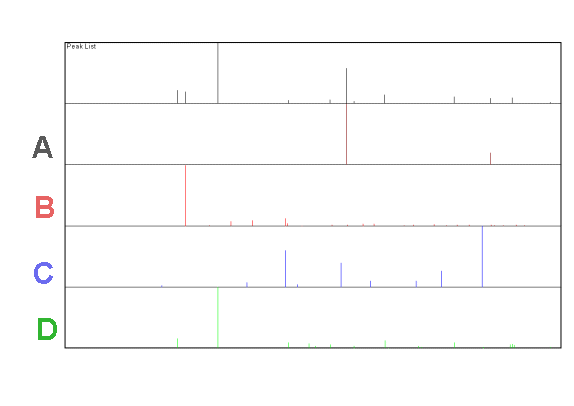
Given these experimental and reference data (A,B,C and D) which phases are:
1. Definitely present
2. Not observable (implies absent at any significant level)
3. Unsure
In each case give a reason for your answer and when unsure consider whether you could do something to clarify the situation.